





Most natural supplements marketed to athletes make claims that run well ahead of the evidence supporting them. Cordyceps mushroom is a notable exception. There is a peer-reviewed, randomized, double-blind, placebo-controlled human clinical trial showing that three weeks of Cordyceps militaris supplementation was associated with improved VO2max and longer time to exhaustion in healthy adults. That is the kind of evidence most natural performance supplements simply do not have.
Among the mushrooms for athletic performance that have moved from traditional use into modern research, cordyceps has the most direct support for the metrics endurance athletes actually care about. Its broader cordyceps mushroom benefits span energy, immunity, and recovery, but this article narrows the focus to performance: the research on cordyceps and exercise, the mechanisms behind the benefits, and practical guidance for working it into training, pre-workout routines, and recovery between sessions.
The Key Clinical Evidence: What Does the Research Actually Show?
The foundational human study is a 2016 randomized, double-blind, placebo-controlled trial published in the Journal of Dietary Supplements. Researchers supplemented healthy adults with Cordyceps militaris extract for three weeks and measured outcomes against a placebo group. Supplementation was associated with improvements in VO2max and time to exhaustion relative to placebo (DOI: 10.1080/19390211.2016.1203386).
These are two of the most meaningful performance metrics that can be measured in an endurance context. VO2max represents the body's maximum capacity to consume and utilize oxygen during sustained effort. Time to exhaustion measures how long a person can sustain a given work output before reaching failure. Both are directly relevant to how athletes perform and how quickly they recover.
A 2021 review in Phytotherapy Research synthesized findings across multiple cordyceps studies and documented that the mushroom supports oxygen utilization, reduces exercise-induced fatigue markers, and demonstrates adaptogenic properties that support the stress response associated with training (DOI: 10.1002/ptr.6911). The mechanistic basis for these findings comes from a 2020 study in Cellular and Molecular Biology showing that cordycepin, the primary active compound in cordyceps, supports ATP production via mitochondrial pathways (DOI: 10.14715/cmb/2020.66.6.2).
Taken together, these three studies form an unusually complete picture for a natural supplement: a measured human outcome (improved VO2max and time to exhaustion), a documented set of supporting effects (better oxygen utilization and reduced fatigue), and a cellular mechanism (mitochondrial ATP production) that explains why the outcome occurs.
How Does Cordyceps Improve Athletic Performance?
Oxygen Utilization and VO2 Max
The performance gains documented in the research trace back to how cordyceps affects oxygen delivery and utilization. VO2max, the measure improved in the 2016 clinical trial, is fundamentally a measure of how efficiently your cardiovascular and muscular systems can deliver and use oxygen at maximal effort. When VO2max improves, the body can sustain higher intensity effort before switching to anaerobic metabolism and accumulating the fatigue byproducts that force you to slow down.
Cordyceps appears to support this through its influence on mitochondrial function and ATP production. More efficient mitochondria mean more ATP from the same oxygen input, which translates to better endurance at any given effort level. This is the core of the cordyceps endurance story: the same oxygen delivered to working muscle is put to more useful work.
Reduced Exercise-Induced Fatigue
Beyond the VO2max findings, multiple studies have examined cordyceps' effect on fatigue markers after exercise. The Phytotherapy Research 2021 review documented evidence that cordyceps reduces exercise-induced fatigue biomarkers. This has practical implications for both performance during training and the speed of recovery between sessions, particularly relevant for athletes training multiple times per week or competing in multi-day events.
Adaptogenic Recovery Support
Training stress is productive stress, but only when the body can recover adequately between sessions. Cordyceps' adaptogenic properties, its ability to support the body's regulation of physical and physiological stress, are relevant to this recovery window. Adaptogens do not blunt the training stimulus; they support the body's ability to process and recover from it. For athletes who are pushing consistent high-volume or high-intensity training, this distinction matters.
Which Sports and Athletes Benefit Most from Cordyceps?
The VO2max and endurance findings are most directly applicable to aerobic sports: running, cycling, swimming, rowing, triathlon, cross-country skiing, and any team sport with significant aerobic demands. These athletes are most dependent on oxygen utilization efficiency, and the mechanisms through which cordyceps supports performance map directly to the physiological limiters in these disciplines.
Strength and power athletes may also benefit, though the picture is different. Sports like powerlifting, sprinting, and Olympic weightlifting are limited primarily by maximal force and the phosphocreatine energy system rather than by aerobic capacity, so the VO2max benefit is less central to a single maximal effort. What does carry over is the ATP production support and the anti-fatigue and recovery properties, which matter for training volume and between-set recovery even in power disciplines. The honest summary: the direct human evidence is strongest for endurance athletes, while strength and power athletes are more likely to notice cordyceps in their recovery and work capacity than in a one-rep max. The anti-fatigue effects documented in the research are relevant to anyone who trains regularly, regardless of sport.
Cordyceps as a Natural Pre-Workout
Interest in natural pre-workout mushrooms has grown as more athletes look for alternatives to high-stimulant pre-workout formulas. Cordyceps fits this category, but it works on a different principle than a typical pre-workout. Stimulant pre-workouts produce an acute surge of alertness by acting on the central nervous system. Cordyceps instead supports the underlying machinery of energy production and oxygen use, an effect that builds with consistent daily use rather than arriving as a single jolt.
That makes cordyceps a natural pre-workout option for athletes who want sustained output and better oxygen economy without the jitters, the elevated resting heart rate, or the eventual crash that high-caffeine products can produce. Many athletes use it in place of a stimulant pre-workout entirely; others keep a cordyceps dose alongside their existing routine purely for the endurance benefit. If you are building a stimulant-free routine, Troomy's natural energy and endurance collection groups cordyceps with other functional mushroom options that work the same way. Either approach is reasonable, and neither carries the tolerance buildup associated with chronic stimulant use.
How Much Cordyceps Should Athletes Take?
The 2016 clinical trial that demonstrated the VO2max improvement used dosages within the range commonly found in quality cordyceps supplements, with the supplementation period running three weeks. Most research protocols fall within a daily dosage range of 1,000 to 3,000mg of extract. The extraction method matters: cordyceps powder without extraction has poor bioavailability because the active compounds are bound within fungal cell walls. Triple-extracted or dual-extracted products are the appropriate choice for athletes seeking the benefits documented in the research.
When Should Athletes Take Cordyceps?
Daily consistency is more important than precise timing for the adaptogenic and chronic performance benefits. Most protocols use morning dosing or pre-exercise dosing. For athletes specifically interested in the endurance and VO2max benefits, taking cordyceps 30 to 60 minutes before training sessions aligns with the oxygen utilization mechanism. For recovery benefits, morning dosing as part of a daily routine supports the consistent adaptogenic effect.
How Long Before Competition Should You Start?
This is where the structure of the research matters most. The benefits in the 2016 trial appeared after three weeks of daily supplementation, not after a single dose. Cordyceps is not a same-day performance trigger; it is a compound that works by building an effect over time. The practical implication for an athlete targeting a specific event is to begin supplementation at least three to four weeks before competition and maintain it daily through that window, so the oxygen-utilization and endurance benefits are well established by race day.
From there, a sensible protocol is to hold the daily dose steady through any taper and into the event itself, including a pre-event dose 30 to 60 minutes before the start to match training-day timing. Because cordyceps is not a stimulant and does not build tolerance, there is no need to cycle off or "save" it for competition the way some athletes periodize caffeine. Consistency from the first week of the build through to the start line is the approach that mirrors how the benefit was demonstrated in the research.
Troomy's Boost Cordyceps Gummies deliver triple-extracted Cordyceps militaris in a consistent, convenient format that makes the daily habit easy to maintain through a full training and competition cycle.
Stacking Cordyceps with Other Supplements for Athletes
Cordyceps combines well with other functional mushrooms and natural performance support compounds. For athletes who need both energy and mental focus during training or competition, pairing cordyceps with Lion's Mane offers complementary support: cordyceps for energy and endurance, Lion's Mane for concentration and cognitive clarity under fatigue. This is a particularly useful stack for long endurance events and skill-based sports, where physical output and sharp decision-making both degrade as fatigue sets in.
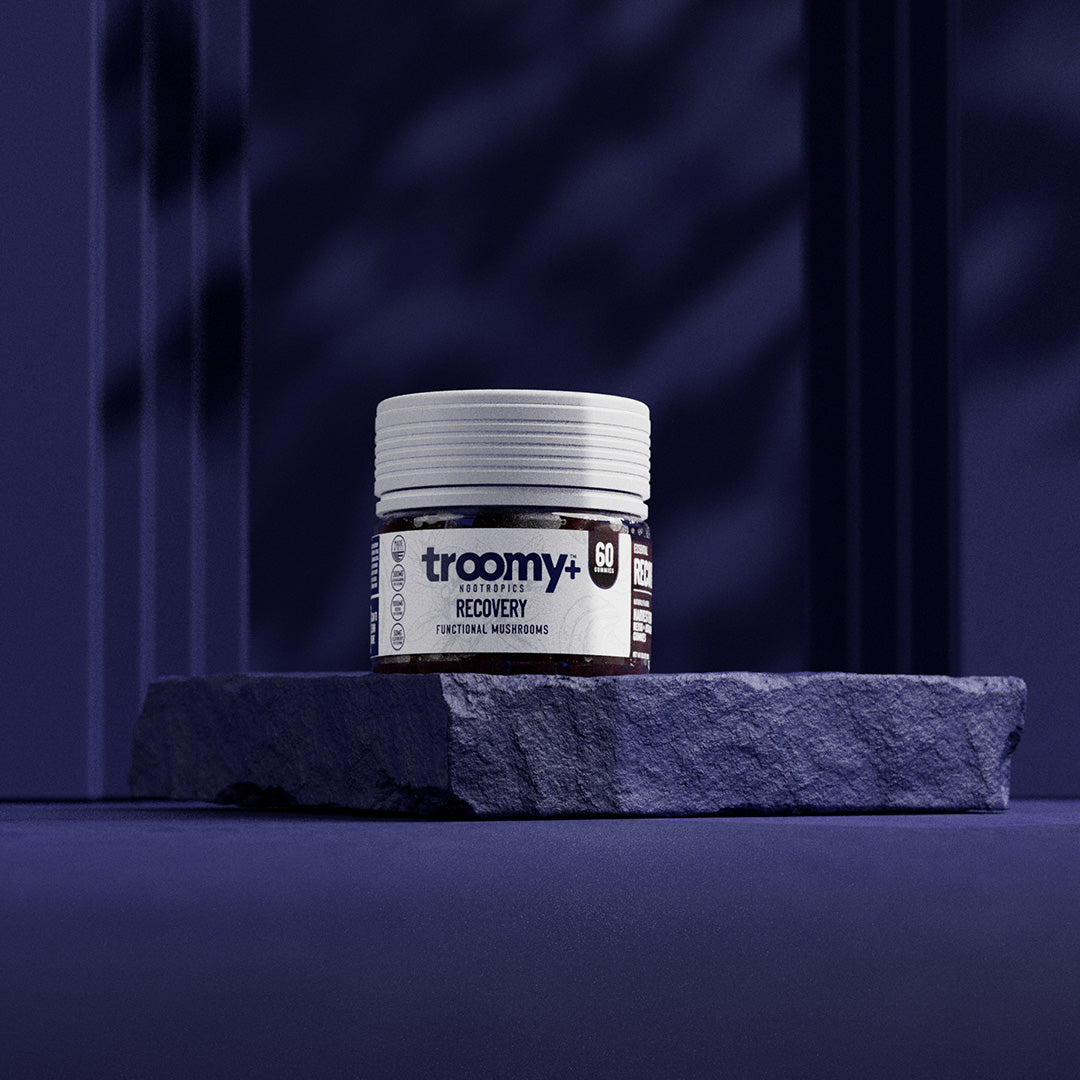
For recovery support, combining cordyceps with Reishi and Ashwagandha is a natural fit. Troomy's Recovery Ashwagandha and Reishi Gummies are designed specifically for this recovery use case, and pairing them with the Boost Cordyceps Gummies provides a comprehensive energy, endurance, and recovery approach within the Troomy range.
Is Cordyceps Safe for Athletes?
Yes. Cordyceps has a strong safety profile based on over a thousand years of traditional use and modern clinical research. It is not a stimulant, does not build tolerance, and does not produce the adrenal fatigue concerns associated with chronic stimulant or pre-workout use.
For athletes subject to drug testing, cordyceps itself is not included on the WADA Prohibited List, as it contains no prohibited stimulants or banned compounds. As with any supplement, the practical risk for tested athletes is not the mushroom but the possibility of contamination during manufacturing, so athletes competing under anti-doping rules should choose products that are third-party tested and confirm the status of any specific formula against current WADA guidance before competition.
Frequently Asked Questions
Does cordyceps improve VO2 max?
Yes, based on the evidence from a 2016 randomized controlled trial published in the Journal of Dietary Supplements, which found that three weeks of Cordyceps militaris supplementation was associated with improved VO2max in healthy adults. VO2max is the primary measure of aerobic capacity and endurance.
How much cordyceps should athletes take for performance?
Human clinical research on athletic performance has used dosages in the range of 1,000 to 3,000mg of extract daily. The key variable is extraction quality. Triple-extracted or dual-extracted products are appropriate because raw powder without extraction has poor bioavailability.
When should athletes take cordyceps?
Daily consistency matters most. Morning dosing or pre-exercise dosing 30 to 60 minutes before training are both logical approaches. For the adaptogenic and chronic endurance benefits, daily use over three to four weeks is the protocol that has demonstrated results in the research, so athletes targeting an event should start three to four weeks out and continue daily through competition.
Can cordyceps replace pre-workout supplements?
It depends on what you are using pre-workout for. If you rely on pre-workout primarily for the stimulant effect and the acute alertness and energy surge, cordyceps works differently and would not replicate that immediate feeling. If you are looking for improved oxygen utilization and sustained endurance support that builds over time without stimulant side effects, cordyceps is a compelling alternative or complement.
These statements have not been evaluated by the Food and Drug Administration. This product is not intended to diagnose, treat, cure, or prevent any disease.


