



You feel run down more often than you should. Your gut has not felt quite right in weeks. And every time you look into natural immune support, one mushroom keeps coming up: turkey tail. Here is what it actually is, what the research shows, and the simplest way to take it.
Turkey tail is a medicinal mushroom studied mainly for two things: supporting normal immune function and feeding beneficial gut bacteria. Most people take it as a daily extract, in a tea, capsule or gummy, and give it at least a month of consistent use before judging it.
What is turkey tail mushroom?
Turkey tail (Trametes versicolor, also sold as Coriolus versicolor) is a thin, fan-shaped mushroom that grows in overlapping layers on dead wood. Its caps carry bands of brown, tan, rust and gray. It looks like a wild turkey's fanned tail, and versicolor means "of several colors."
The mushroom is too tough and leathery to cook, so it has traditionally been simmered into tea. It is known as yun zhi in China and kawaratake in Japan, and it has a long history in the traditional medicine of both countries. Today it is sold in teas, powders, capsules, coffee blends and gummies, made from the fruiting body (the visible mushroom), the mycelium (the root-like network), or both.
How do you tell turkey tail from look-alikes?
Several wild fungi look like turkey tail at a glance, and the best known is false turkey tail (Stereum ostrea). The quickest check is underneath the cap. Real turkey tail has a pale underside covered in tiny pores, while false turkey tail is smooth underneath. Real turkey tail is also thin and flexible, with fine, velvety hairs on its upper surface.
That matters if you forage, but most people never need to. A supplement from a brand that names the species, lists the part of the mushroom it uses and tests its products takes the guesswork out entirely.
What are the benefits of turkey tail?
Supports normal immune function
Turkey tail is rich in beta-glucans, the long glucose chains that make up much of a mushroom's cell wall. Immune cells carry receptors that recognize them, and fungal beta-glucans are the most studied compounds that come from mushrooms, with more than 20,000 published studies (Immunomodulating Effects of Fungal Beta-Glucans, Nutrients, 2021).
Most of this research comes from lab, animal and small human studies. It supports turkey tail as a mushroom for normal immune function. It does not show that a supplement keeps you from catching colds, and no large trial in healthy adults has tested that.
Feeds beneficial gut bacteria
Your gut and immune system are closely linked: an estimated 70 to 80 percent of immune cells are found in the gut (Wiertsema et al., Nutrients, 2021). Turkey tail's polysaccharides resist digestion and reach the large intestine, where gut bacteria ferment them. In a lab study using human stool samples, a turkey tail polysaccharide extract increased Bifidobacterium and Lactobacillus, the same groups that well-known prebiotic fibers encourage (Yu et al., Plant Foods for Human Nutrition, 2013). In a small randomized trial, healthy adults who took a turkey tail polysaccharide extract daily for two weeks showed gut microbiome changes consistent with a prebiotic effect (Pallav et al., Gut Microbes, 2014).
That trial was small and open-label, it used a high dose of purified extract, and it measured bacteria rather than symptoms. So the fair way to describe turkey tail is as a potential prebiotic, not a proven one.
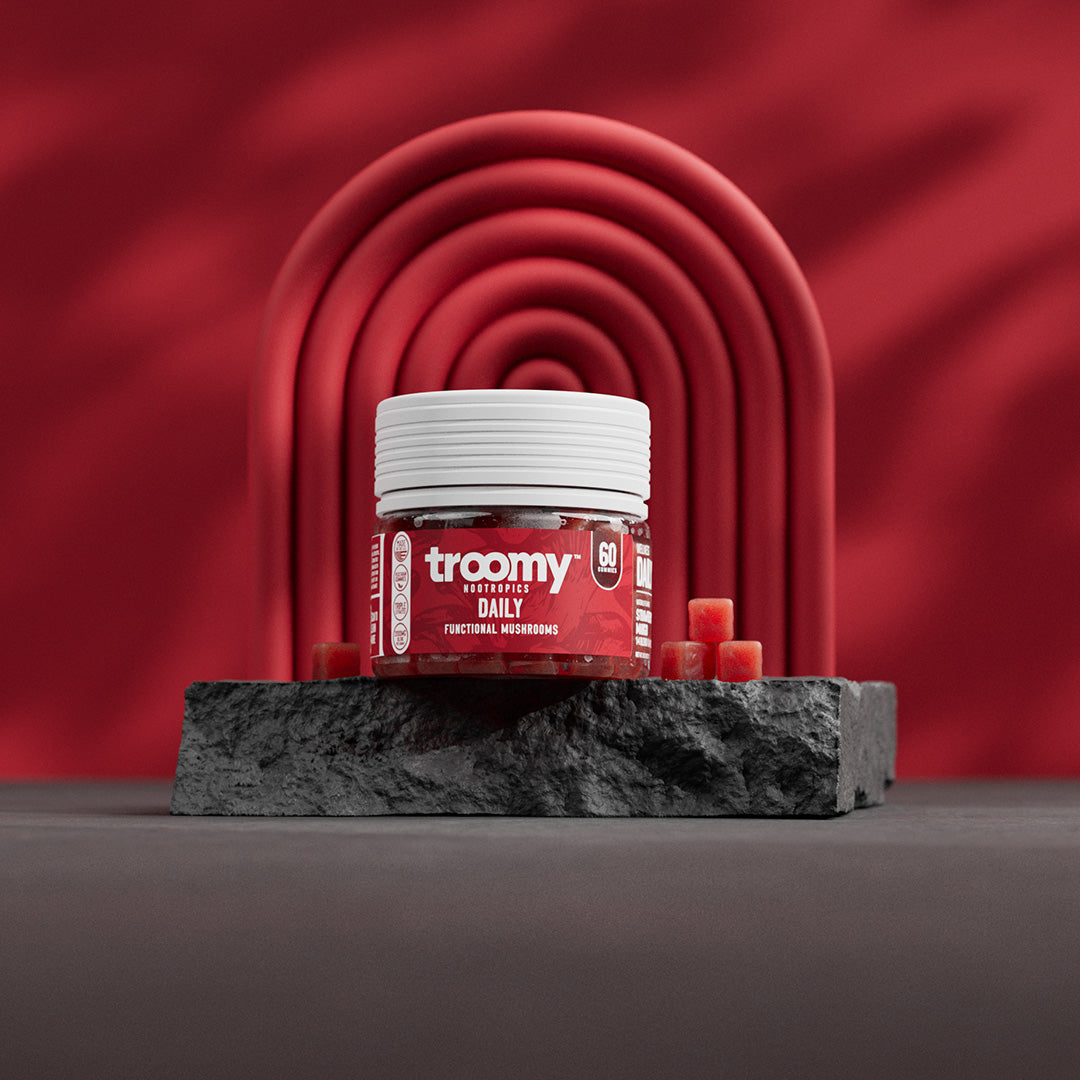
Want immune support without building a cabinet full of bottles? Troomy's Daily 14 Mushroom Blend gummies combine turkey tail with 13 other functional mushrooms in one triple-extracted, vegetarian gummy, made in the USA.
Why is turkey tail one of the most researched functional mushrooms?
The answer is its chemistry. Beyond its beta-glucans, turkey tail contains two protein-bound polysaccharides, PSK and PSP, and those compounds are a big part of why scientists have studied this mushroom so closely for so long. That long research history is why turkey tail comes up in almost every conversation about immune mushrooms.
What matters for you is narrower: what has been shown for turkey tail itself, in people, at everyday amounts. That evidence is smaller and more modest, which is why this guide sticks to supporting normal immune function and gut health, and points out where the human research is still limited.
Is turkey tail safe to take?
For most healthy adults, turkey tail appears to be well tolerated. In the main human trial, no serious adverse events were recorded, and the only side effect linked to turkey tail was extra gas and burping in one participant (Pallav et al., Gut Microbes, 2014). Allergic reactions are possible, especially in people who react to mold or other mushrooms.
Check with a healthcare provider before starting if you are pregnant or nursing, under medical care, taking prescription medication, or have a mushroom or mold allergy. Everyone else can start at the label dose and add nothing else new that week, so any reaction is easy to spot.
How does turkey tail compare with other immune mushrooms?
Reishi is the other mushroom most people consider. Both support normal immune function, but reishi is also used for stress and sleep, while turkey tail leans toward gut support. Chaga is studied mainly for its antioxidant compounds.
If stress and poor sleep are part of why you feel run down, reishi may suit you better than turkey tail. Turkey tail, reishi and chaga are the three that lead our ranking of the best immune mushrooms, and all three are in Troomy's Daily 14. Reishi's own immune research centers on its beta-glucans and triterpenes, and most functional mushroom blends combine several species because each one brings different compounds.
How do you take turkey tail?
Pick a format you will take every day
Tea is the traditional route. It is inexpensive, but it means simmering the dried mushroom, and the taste is earthy. Powders mix into coffee or smoothies, though many are plain ground mushroom rather than an extract, so read the label. Capsules are neutral and portable. Gummies are the easiest to take daily, as long as each one carries a meaningful amount of extract.
How do you make turkey tail tea?
Break dried turkey tail into small pieces and simmer them gently in water rather than steeping them like a tea bag, because the tough caps give up their compounds slowly. Strain out the pieces and drink it plain, or add honey or lemon to soften the earthy taste. A large batch keeps in the fridge for a few days and saves time. Tea suits people who enjoy a ritual, but it is harder to keep the amount consistent from cup to cup than with a measured capsule or gummy.
Choose an extract
Beta-glucans sit inside a tough chitin cell wall that people digest poorly, and extraction with hot water is the standard way researchers draw mushroom polysaccharides out (Wachtel-Galor et al., NCBI Bookshelf, 2011). That is why extracts are preferred over raw mushroom powder. Troomy triple-extracts every mushroom it uses.
Fruiting body or mycelium?
The fruiting body is the mushroom you see on a log. The mycelium is the network of threads that grows through the wood, and in supplements it is often grown on grain such as oats or rice. The two are different parts of the organism, so they are not interchangeable on a label. Neither is automatically better. What matters is that the label tells you which one you are getting, so you can compare like with like. Daily 14 states that its blend uses both fruiting bodies and mycelium.
When to take it and how much
Follow the serving size on your product label. Turkey tail is not a stimulant, so timing is flexible. Most people take it with breakfast so it becomes part of a routine, and taking it with food can help if your stomach is sensitive. Stay consistent for at least 30 days before deciding whether it works for you.
How much turkey tail is in a supplement?
It varies widely, and the label is the only reliable guide. Single-mushroom products usually state the amount of turkey tail extract per serving in milligrams, which makes them easy to compare. Blends often list one total for all their mushrooms, as Daily 14 does, without breaking out each one. Neither approach is wrong, but they suit different goals. If you want a specific amount of turkey tail, choose a single-mushroom product and follow its serving size. If you want broad daily support from several mushrooms, a blend is simpler. Either way, be wary of any product that does not say how much mushroom it contains at all.
What is in Daily 14?
Daily 14 contains a 2,000 mg blend of 14 mushrooms per serving, including turkey tail, reishi, chaga, lion's mane, cordyceps and maitake, in a Strawberry Mango gummy. A 60-count bottle is $39.99, about $0.67 per gummy (troomy.com, October 2026). The amount of turkey tail in the blend is not disclosed, so you get it as part of a broad blend, not a single-mushroom dose. If you also want a dedicated reishi gummy for stress, Calm Reishi sits next to Daily 14 in the Immunity Collection.
Who is turkey tail best for?
Turkey tail fits best if you feel run down more often than you would like, your digestion has felt off, and you want one steady daily habit rather than a shelf of products. It also suits people who already eat well and sleep reasonably but want an extra layer of everyday support.
It is a weaker fit if you want something you can feel within an hour, like caffeine, or if stress and poor sleep are your main problem, in which case reishi is the more focused choice. And it is not a substitute for medical care if you are dealing with a health condition.
What should you expect?
Turkey tail will not make up for short sleep or a diet low in vegetables, beans and whole grains. It adds one more layer of everyday support. Take it daily, then judge it on how a normal month feels.
Feeling run down and want one simple daily habit? Try Daily 14 Mushroom Blend gummies: turkey tail plus 13 more functional mushrooms in one gummy, at about $0.67 a gummy (troomy.com, October 2026).
Frequently Asked Questions
What is turkey tail mushroom good for?
Turkey tail is mainly used to support normal immune function and gut health. Its beta-glucans and protein-bound polysaccharides are among the most studied compounds in functional mushrooms, and early research shows its polysaccharides can feed beneficial gut bacteria. Most of the evidence comes from lab and small human studies.
Is turkey tail safe to take every day?
Turkey tail appears to be well tolerated, and supplements are designed for daily use. Allergic reactions are possible, especially if you react to mold or other mushrooms. Check with a healthcare provider first if you are pregnant or nursing, under medical care, or taking prescription medication.
How long does turkey tail take to work?
Give it at least 30 days of consistent daily use before you judge it. Turkey tail is not a stimulant, so you will not feel it the way you feel coffee. In the human gut study, changes in gut bacteria were measured over weeks.
What is the best way to take turkey tail?
Use a format you will take every day, and choose an extract rather than plain ground mushroom. Tea is traditional, capsules are neutral, and gummies are the easiest to stick with. Follow the serving size on the label.
Is turkey tail the same as reishi?
No. They are different mushrooms. Both support normal immune function, but reishi is also used for stress and sleep, while turkey tail leans toward gut health. Troomy's Daily 14 gummies include both.
What does turkey tail taste like?
Turkey tail tea tastes earthy and slightly bitter, and the mushroom itself is too tough to eat. In a gummy you do not taste it. Troomy's Daily 14 gummies are Strawberry Mango.
Can you take turkey tail with other mushrooms?
Yes. Turkey tail is often combined with reishi, chaga, lion's mane and others, and many blends, including Troomy's Daily 14, contain several. Check your labels so you know how many of your products already include turkey tail, and add one new product at a time so you can tell how each one sits with you.
These statements have not been evaluated by the Food and Drug Administration. This product is not intended to diagnose, treat, cure, or prevent any disease.


