



False chaga (Phellinus igniarius) is a birch conk that closely resembles real chaga but contains none of the bioactive compounds that give chaga its health benefits. Understanding the difference is essential whether you are foraging in northern forests or evaluating a supplement label.
Chaga mushrooms have earned a permanent place in the functional wellness conversation, and for good reason. But with that popularity has come a surge of look-alikes in the wild and, increasingly, in supplement products that cut corners on sourcing. Below, we break down exactly what separates real chaga from its impostors, where genuine chaga grows, and the smartest way to get it into your routine without the risk of misidentification.
What Is Chaga?
Chaga is technically not a mushroom in the traditional sense. A mushroom is defined as the spore-bearing fruiting body of a fungus. Chaga is a sclerotium, a dense mass of hardened fungal tissue that grows out of its host tree as part of a parasitic relationship. It draws nutrients from the tree while developing the compounds that make it valuable: betulinic acid derived from birch bark, beta-glucans, polysaccharides, and an extraordinarily dense concentration of antioxidants.
Historically used in folk medicine traditions across Russia, Siberia, and Northern Europe, chaga has since attracted serious scientific interest for its potential role in immune support, inflammation management, and overall cellular health. It grows primarily in cold northern climates on birch, alder, beech, and maple trees throughout Canada, Russia, and parts of the Northern United States.
What Are the Benefits of Chaga Mushrooms?
Chaga's reputation is built on a well-rounded set of functional properties that make it appealing as a daily supplement. Its high concentration of beta-glucans supports immune system activity, while its antioxidant load helps the body manage oxidative stress. Research has also explored chaga's potential role in modulating inflammation and supporting healthy blood sugar and cholesterol levels.
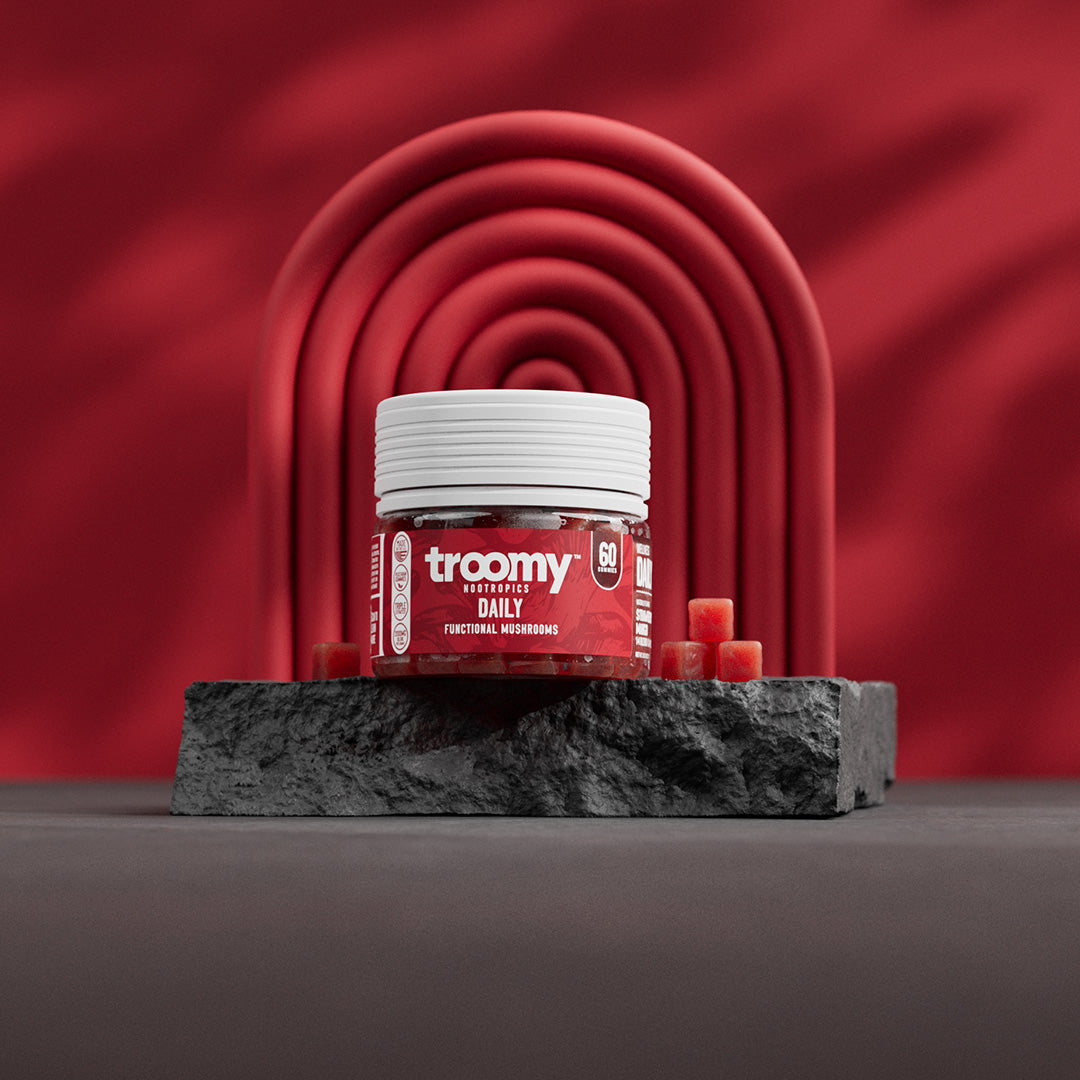
For most people, the goal is finding a consistent, high-quality source of chaga rather than a single isolated benefit. That is why products like Troomy's Daily 14 Mushroom Blend Gummies pair triple-extracted chaga with 13 other functional mushrooms at 2,000mg per gummy, delivering broad-spectrum support without requiring you to forage or identify the fungus yourself.
Side effects are minimal for most people, though those on blood-thinning medications or with known mushroom sensitivities should consult a healthcare provider before adding chaga to their wellness routine.
What Is False Chaga?
False chaga is any fungal growth or tree formation that closely resembles genuine chaga (Inonotus obliquus) in appearance but lacks its functional properties. The most common false chaga look-alike is Phellinus igniarius, commonly called tinder conk, along with various tree burls that mimic chaga's dark, irregular exterior. Knowing the difference matters because chaga's real value, its antioxidants, betulinic acid, and beta-glucans, belongs exclusively to the genuine fungus, not its impostors.
False chaga does not offer a substitute for real chaga, and in some cases consuming unknown fungal growths in the wild carries its own risks. This makes confident identification a genuinely practical skill for anyone interested in wild foraging.
Chaga Look-Alikes: The Fungi Most Commonly Confused with Real Chaga
There are two primary chaga look-alikes that fool even experienced foragers: tinder conk (Phellinus igniarius) and tree burls. Both share enough visual characteristics with true chaga to create real confusion in the field.
Tinder Conk (Phellinus igniarius)
Tinder conk is the fungus most frequently mistaken for chaga. It grows on similar hardwood trees, including birch, and shares chaga's dark, crusty exterior. The key differences become clear on closer inspection. Tinder conk forms in a rounded, hoof-like shape, whereas genuine chaga develops in an irregular, cone-like mass that looks almost as though it erupted from the tree. The most diagnostic difference is the interior: tinder conk reveals a pale, grey, or off-white interior when cut, compared to chaga's warm orange-brown.
Tinder conk also lacks chaga's bioactive compounds entirely. It has been used historically as a fire-starting material, which is how it earned its name, but it has no meaningful nutritional or functional properties relevant to wellness supplementation.
Tree Burls
Tree burls are abnormal woody growths caused by stress, disease, or infection in the host tree. They are not fungi at all, but they are regularly mistaken for chaga because of their dark, gnarled exterior and irregular shape. Burls can appear on almost any tree species, which is one of the clearest ways to distinguish them: if you are looking at a dark growth on an oak, elm, or pine, it is almost certainly a burl rather than chaga.
Unlike chaga, burls have no distinct interior coloring when cut and no bioactive compounds of functional interest. If a growth has a pale, fibrous, or wood-like interior, it is not chaga.
How to Identify Chaga in the Wild
Real chaga has a charred, black exterior that looks almost like a piece of burnt wood embedded in the tree. Crack it open, and the interior reveals a warm orange-brown color, one of the clearest indicators you are looking at genuine chaga rather than a false chaga mushroom. Its shape is irregular and cone-like, almost as though the tree itself erupted outward at that point.
When evaluating a growth in the field, work through these questions systematically:
-
Is this growing on a birch, alder, beech, or maple tree? Chaga has preferred hosts, and finding a dark growth on a pine or oak is a strong signal you are not looking at chaga.
-
Is the exterior charred black? True chaga has an almost burnt appearance on the surface.
-
Does the interior show a warm orange-brown color when broken or cut? This is the most reliable single indicator of authentic chaga.
-
Is the shape irregular and cone-like rather than rounded or hoof-shaped? Rounded, symmetrical growths are more characteristic of tinder conk.
-
Are you in a cold, northern climate? Chaga thrives in climates with cold winters. Spotting a chaga-like growth in the American South or in a warm coastal region is a reason for skepticism.
If you cannot confidently answer yes to the interior color test and the host tree check, it is worth leaving the growth alone. Misidentification in foraging is not just frustrating, it means you may be consuming something with an entirely different biological profile and no functional benefit.
Where Does Chaga Grow?
Chaga is a cold-climate fungus. In the United States, it is most reliably found in Minnesota, the Pacific Northwest, and pockets of the Northeast. Internationally, Russia, Siberia, and parts of Canada represent its primary natural habitat.
Wild chaga grows almost exclusively on living or recently dead hardwood trees, particularly birch. That host relationship is precisely what gives chaga its betulinic acid content: the compound is derived from birch bark and absorbed into the fungal tissue. Cultivated chaga, grown in controlled environments on grain or rice-based substrates rather than birch trees, is more widely available commercially but may not carry the same concentration of birch-derived compounds.
A 2023 peer-reviewed review published in International Journal of Medicinal Mushrooms notes that while artificial cultivation of chaga has shown promise, wild chaga grows slowly on its host tree over many years, and the long-term impact of increased commercial harvesting remains an open question given how slowly populations recover.
Can I Harvest Chaga Sustainably?
Sustainable chaga harvesting is possible but requires genuine patience and commitment. Because chaga can take up to 20 years to fully mature on a host tree, over-harvesting has real ecological consequences that affect both the fungus and the host tree's health. If you do harvest wild chaga, the standard recommendation is to leave at least a third of the growth intact so the fungus has the capacity to regenerate.
For most people interested in chaga's benefits, sourcing it through foraging is not a practical daily strategy. The combination of scarcity, long maturation cycles, the real risk of confusing chaga with a look-alike, and the ecological responsibility involved makes purpose-built supplements a far more consistent option. A high-quality, triple-extracted chaga supplement delivers the same bioactive compounds without the uncertainty or the impact on wild populations.
Chaga vs. Chaga Look-Alikes: A Quick Field Reference
True chaga produces an irregular, cone-like shape with a charred black exterior and a warm orange-brown interior. It grows almost exclusively on birch trees in cold northern climates. Tinder conk (Phellinus igniarius) forms a rounded, hoof-like shape with a grey-brown exterior and a pale interior, and it grows on a wider variety of hardwoods. Tree burls are smooth or gnarled woody growths with no distinct interior coloring and can appear on nearly any tree species.
The interior color test is your most reliable single field indicator. True chaga always reveals that warm, rusty orange-brown when cut or broken. If what you are looking at has a pale, grey, or white interior, you are almost certainly looking at a false chaga mushroom or another type of fungal growth entirely.
How to Get Real Chaga Without the Guesswork
For most people interested in chaga's benefits, the most reliable approach is a high-quality supplement from a brand that is transparent about sourcing and extraction methods. That means looking for triple-extracted chaga to ensure the full spectrum of active compounds is bioavailable, and choosing a product that is third-party tested and made in the USA.
If you want to explore chaga alongside a broader spectrum of functional mushrooms, Troomy's Daily 14 Mushroom Blend Gummies combine triple-extracted chaga with 13 other functional mushrooms, including lion's mane for focus, cordyceps for energy, and reishi for calm, at 2,000mg per gummy. It is the kind of complete daily support that would take a serious foraging operation to replicate on your own. One gummy, fourteen mushrooms, zero guesswork about whether you have found the real thing.
You can also explore Troomy's full immunity collection for products built around mushrooms with the strongest immune support profiles, all triple-extracted, vegetarian, made in the USA, and available in natural flavors people actually enjoy.
For a deeper dive into what makes chaga one of the most studied functional mushrooms available, visit our complete guide: Chaga Mushroom: Benefits, Uses and How to Take It.
Final Thoughts on False Chaga and Finding the Real Thing
Chaga is genuinely one of the most compelling functional mushrooms available, but its look-alikes are convincing enough that even seasoned foragers get it wrong. False chaga mushrooms, tinder conk, and tree burls share enough visual characteristics with true chaga that confident field identification requires careful attention to shape, interior color, host tree species, and climate. The interior orange-brown test is your clearest indicator, but it is not a substitute for understanding the full picture.
If you are building a functional wellness routine around chaga and other adaptogenic mushrooms, you do not need to become an expert mycologist to benefit from them. Quality supplements give you exactly what you are looking for, verified, consistent, and ready to work, without the weeks of research and the very real risk of coming home with a tinder conk.
Start with Troomy's Daily 14 Mushroom Blend, explore the full immunity collection, and find the version of functional mushroom support that actually fits your life. That is the whole point.
Frequently Asked Questions
What is false chaga?
False chaga refers to any fungal growth or tree formation that resembles genuine chaga (Inonotus obliquus) in appearance but lacks its functional compounds, including beta-glucans, betulinic acid, and antioxidants. The most common false chaga look-alike is Phellinus igniarius, commonly known as tinder conk, along with various tree burls that share chaga's dark, irregular exterior.
What does false chaga look like?
False chaga, particularly tinder conk (Phellinus igniarius), shares chaga's dark, crusty exterior and can be found on similar hardwood trees. The key difference is in the shape and interior. Tinder conk forms a rounded, hoof-like growth with a pale, grey, or off-white interior when cut. True chaga has an irregular, cone-like shape and a distinctive warm orange-brown interior. Tree burls, the other common false chaga, have a woody interior with no distinctive color.
Is false chaga dangerous?
False chaga, particularly tinder conk, is not known to be toxic, but consuming unknown fungal growths from the wild carries inherent risk. More practically, consuming a false chaga mushroom means receiving none of the bioactive compounds you were seeking. It has no meaningful wellness benefit and is not a substitute for real chaga. When in doubt, avoid consuming unidentified wild fungi.
How do I identify real chaga?
Real chaga can be identified by four key characteristics: an irregular, cone-like shape rather than a rounded or hoof-like growth; a charred black exterior; a warm orange-brown interior when cut or broken; and growth almost exclusively on birch, alder, beech, or maple trees in cold northern climates. The interior color test is the single most reliable indicator. A pale, grey, or white interior almost always indicates a false chaga mushroom or another fungal growth.
What are common chaga look-alikes?
The most common chaga look-alikes are tinder conk (Phellinus igniarius), which forms a rounded, hoof-like fungal growth on hardwood trees with a pale interior, and tree burls, which are abnormal woody growths caused by stress or infection that can appear on many different tree species. Both share chaga's dark exterior but differ significantly in shape, interior color, and the type of trees they grow on.
Can false chaga make you sick?
Tinder conk is not known to be acutely toxic, but consuming any unidentified wild fungus carries some risk, and the specific effects of ingesting tinder conk in quantity are not well studied. More significantly, consuming false chaga means you are not getting the beta-glucans, betulinic acid, or antioxidants you were looking for. If you want the benefits of chaga without the risk of misidentification, a triple-extracted chaga supplement from a reputable brand is the safest and most consistent option.
These statements have not been evaluated by the Food and Drug Administration. This product is not intended to diagnose, treat, cure, or prevent any disease.


