



Once you decide to add chaga to your routine, the next question is the obvious one: how much should you actually take? It is a fair question and a slightly tricky one, because chaga comes in several forms and the numbers are not always comparable across them. This guide lays out the typical dosage range, explains the crucial difference between powder and extract, and covers timing, consistency, and safety, so you can dose chaga with confidence.
For the full background on what chaga is and how it works, our complete chaga benefits guide is the place to start.
How Much Chaga Should You Take Per Day?
For chaga extracts, the dosage range commonly cited in research and traditional use sits around 1,000 to 3,000mg per day. That is the range most people aim for when using a standardized chaga extract supplement. The important caveat is that optimal human dosage has not been firmly established in large clinical trials. A 2025 review of chaga in the journal Current Issues in Molecular Biology underscores this point: while chaga’s bioactive compounds, including beta-glucans, triterpenoids, and polyphenols, are well characterized in laboratory and animal studies, the evidence base in humans is still developing. In practice, that means the figures you see reflect common usage and the broader beta-glucan literature, where daily intakes in the low grams are typical, rather than a precise prescription you should treat as medical advice.
A sensible approach is to start at the lower end of the range, stay consistent, and give it time before adjusting. With functional mushrooms, steady daily intake matters far more than chasing a high number.
Powder vs Extract: Why the Milligrams Are Not Comparable
This is the single most important thing to understand about chaga dosing, and it trips up a lot of people. Raw chaga powder and chaga extract are not interchangeable, milligram for milligram. Raw powder is simply ground-up chaga, and your body cannot easily access the locked-in bioactive compounds because they are bound up in tough fungal cell walls. An extract concentrates those compounds and makes them bioavailable, so a smaller amount of extract can deliver far more active compound than a larger amount of raw powder.
In other words, 1,000mg of a quality extract is not the same as 1,000mg of raw powder. It is the same principle behind lion’s mane dosing, where extract and whole-powder milligrams are not comparable either, so a number on a label only means something once you know which form it describes. When you compare products, look for extracts and check what the milligram figure actually refers to. This matters for quality as much as for strength. A 2025 analysis of commercial chaga supplements found that some products sold as chaga are really mycelium grown on grain, which is high in starch and low in the beta-glucans that make true chaga worthwhile, a reminder that not every milligram on a label is created equal. A triple-extracted chaga, which uses water, alcohol, and heat to capture both water-soluble and fat-soluble compounds, gives you the most complete and bioavailable dose, and it is the reason simply brewing or simmering raw chaga leaves much of its value locked inside those tough cell walls.
When Is the Best Time to Take Chaga?
Chaga is flexible on timing, but the most common and practical choice is morning, often with food or alongside your coffee. Taking it earlier in the day fits chaga's role as a daily antioxidant and immune supporter, and pairing it with a meal can be gentler on the stomach. Unlike reishi, which many people take in the evening for its calming benefits, chaga has no strong reason to be taken at night. The best time, ultimately, is whenever you will remember to take it consistently.
Should You Take Chaga With Food?
Taking chaga with food is a reasonable default. Some of chaga's beneficial triterpenes are fat-soluble, so having it alongside a meal that contains some fat may help with absorption, and food can reduce the chance of any minor stomach upset. That said, chaga is generally well tolerated on its own too. If you use a gummy format, this becomes a non-issue, since you can simply take it whenever fits your routine.
How Long Does Chaga Take to Work?
Chaga is a long-game supplement, not a same-day pick-me-up. Because its benefits center on antioxidant protection and gradual immune support, most people use chaga consistently for several weeks before they notice a difference in how they feel. There is no dramatic immediate effect to expect, and that is normal. The takeaway is to commit to daily use for at least a few weeks before judging results, and to prioritize consistency over dose size. The immune benefits in particular tend to build over time, since they come from steadily supplying your body with beta-glucans and antioxidants rather than from a single large dose. Think of it the way you think of a daily habit like hydration or sleep, where the payoff shows up through repetition, not from one big effort. If you have been taking chaga for a few weeks and want to fine-tune, that is the moment to consider nudging your dose toward the upper end of the range rather than starting high on day one.
Can You Take Too Much Chaga?
Chaga is generally well tolerated, but more is not better, and there are real reasons to stay within sensible amounts. Chaga contains oxalates, compounds that, in large quantities, can be a concern for kidney health, particularly for anyone with a history of kidney stones or kidney issues. This is one of the clearest reasons not to megadose. Doubling up on chaga will not double the benefit, but it can raise your oxalate load, so the upper end of that 1,000 to 3,000mg range is a ceiling to respect rather than a target to exceed. Chaga may also interact with blood-thinning and blood-sugar medications, which is worth flagging to your doctor if you take either. There is not enough research to recommend chaga during pregnancy or breastfeeding. As with any supplement, sticking to recommended amounts and checking with a healthcare provider if you take medication or have an existing condition is the safe approach, and it is one Troomy always encourages.
The Easiest Way to Get a Consistent Chaga Dose
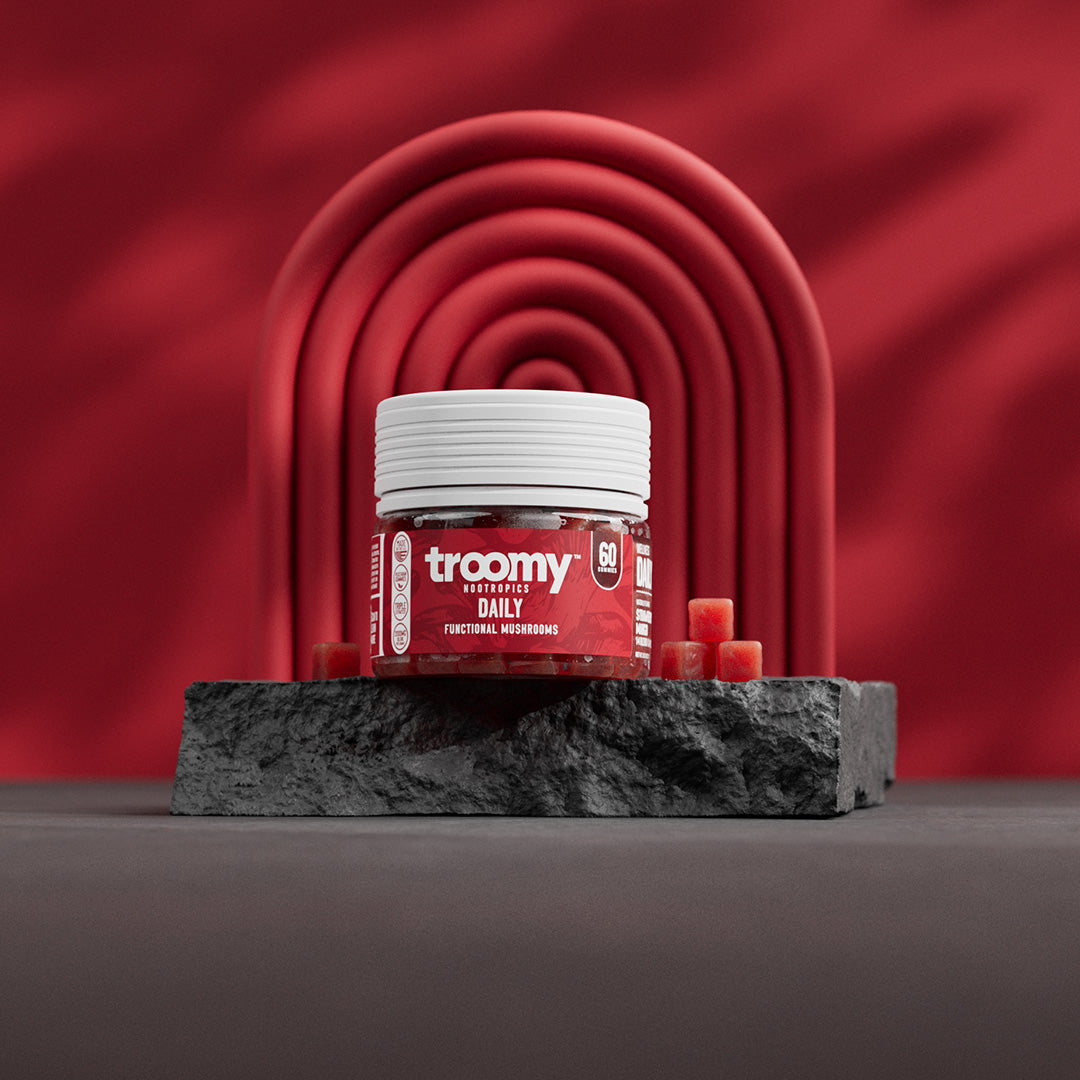
The hardest part of any supplement is not the dose, it is the consistency. The format that fits your life is the one that works. Our Daily 14 Mushroom Blend Gummies deliver triple-extracted chaga as part of a 2,000mg blend of fourteen functional mushrooms per serving, with a suggested use of one gummy per serving up to three times daily. To be clear, that 2,000mg is the combined blend rather than chaga on its own, so if you want chaga as a single high-dose extract this is not that product. What it does give you is consistent, bioavailable, triple-extracted chaga every day inside a broader daily-wellness formula, which for most people is exactly the kind of steady intake that matters more than chasing a big single-ingredient number. They are made in the USA, vegetarian, and come in a strawberry mango flavor, which removes every excuse to skip a day. You get a reliable, bioavailable dose without weighing powders or simmering chaga for an hour.
If immune support is your main goal, the Immunity Collection brings together our most immune-focused formulas so you can build the routine that suits you.
Frequently Asked Questions
How much chaga should I take per day?
For chaga extracts, a commonly cited daily range is around 1,000 to 3,000mg, based on research and traditional use. Optimal human dosage has not been firmly established in large clinical trials, so it is sensible to start at the lower end, stay consistent, and prioritize daily intake over a high number.
Is 500mg of chaga enough?
It depends on the form. With a concentrated, bioavailable extract, a smaller amount can deliver meaningful active compounds, whereas 500mg of raw powder provides far less usable compound because the bioactives are locked in tough fungal cell walls. Always check whether a product's milligram figure refers to extract or raw powder, since they are not comparable.
Can you take too much chaga?
Yes, more is not better. Chaga contains oxalates, which in large amounts can be a concern for kidney health, especially for anyone prone to kidney stones. Chaga may also interact with blood thinners and blood-sugar medication. Stick to recommended amounts and consult a healthcare provider if you take medication or have an existing condition.
When is the best time to take chaga?
Morning is the most common and practical time, often with food or alongside your coffee, which suits chaga's role as a daily antioxidant and immune supporter. Unlike reishi, chaga has no strong reason to be taken at night. The best time is ultimately whenever you will remember to take it consistently.
How long does chaga take to work?
Chaga is a long-game supplement. Because its benefits center on antioxidant protection and gradual immune support, most people use it consistently for several weeks before noticing a difference. There is no instant effect, so commit to daily use for at least a few weeks and prioritize consistency over dose size.
Should I take chaga with food?
Taking chaga with food is a reasonable default. Some of its beneficial triterpenes are fat-soluble, so pairing it with a meal containing some fat may help absorption, and food can reduce the chance of minor stomach upset. Chaga is generally well tolerated on its own too, and gummies can be taken whenever fits your routine.
These statements have not been evaluated by the Food and Drug Administration. This product is not intended to diagnose, treat, cure, or prevent any disease.


