



You have probably seen chaga pop up in your wellness feed, on coffee labels, or in mushroom gummies, and wondered what it actually is. The name sounds exotic, the photos look like burnt charcoal stuck to a tree, and the claims can get overheated fast. So let us slow down and start at the beginning. This is your plain-language guide to what chaga is, where it comes from, why people have called it the King of Mushrooms for over a thousand years, and whether it deserves a spot in your routine. No hype and no overheated promises, just a clear look at one of the most talked-about mushrooms in wellness right now and what the evidence actually says about it.
What Is Chaga Mushroom?
Chaga (Inonotus obliquus) is a fungus that grows primarily on living birch trees in cold northern climates. Here is the fun curveball: chaga is not technically a mushroom in the everyday sense. It does not form the familiar cap and stem you picture when you hear the word. Instead, it grows as a hard, irregular black mass called a sclerotium, a dense lump of fungal tissue and birch wood that erupts from the side of the tree. As the fungus grows, it draws nutrients and compounds directly from its birch host over a span of years, which is part of what gives chaga its distinctive chemistry. It is classified as a medicinal mushroom because of its rich bioactive profile, even though, botanically, it behaves more like a woody conk than a classic mushroom.
Is Chaga a Mushroom or a Fungus?
Technically, chaga is a fungus, and that black mass you see is not the full organism but a sterile growth produced as the fungus feeds on the birch. People call it a mushroom because it sits in the medicinal mushroom category alongside reishi, lion's mane, and cordyceps, and because that is simply how the wellness world refers to it. So both answers are fair: chaga is a fungus, and it is commonly and reasonably called a medicinal mushroom.
What Does Chaga Look Like?
Chaga is unmistakable once you know it. The exterior is dark, cracked, and charcoal-black, looking very much like burnt wood, which is concentrated melanin rather than char. Crack it open and the inside is a striking rusty orange or golden brown, sometimes with a corky, woody texture. That dramatic color contrast is one of its signatures, and the deep black coating is actually one of the richest natural sources of melanin in the fungal world. Because chaga's appearance can be confused with other birch growths, and because misidentifying a wild fungus can mean harvesting the wrong thing entirely, correct identification matters. That is exactly why a standardized supplement removes the risk and guesswork of foraging.
Where Does Chaga Grow?
Chaga thrives in cold climates, growing on birch trees across Siberia, Russia, Northern and Eastern Europe, Canada, Alaska, and the northern United States. It favors harsh, frigid environments, and many enthusiasts believe the cold stress is part of what concentrates its beneficial compounds. Chaga grows slowly, often taking several years to mature into a harvestable size, and a single growth can take a decade or more to fully develop. That slow timeline is part of why wild harvesting raises real sustainability concerns, since chaga cannot simply be replanted and regrown on demand. It is also why cultivated and carefully extracted chaga have become so important for a reliable, responsible supply that does not strip wild birch forests.
Why Is Chaga Called the King of Mushrooms?
The title comes from traditional Russian and Siberian medicine, where chaga has been used for centuries, with records of medicinal use stretching back over a thousand years in Eastern Europe and Russia. The word "chaga" itself is borrowed from Russian, believed to trace back to the Komi language of Siberia, where it described the unusual growth found on birch trees. For the hunters, herbalists, and rural families of the cold north, chaga was a household remedy long before anyone could explain why it seemed to help. It was simmered into a dark, coffee-like brew and passed down through generations as a daily tonic for resilience and vitality, and that long folk-medicine reputation is the first half of how it earned its crown.
Modern science has given the nickname new weight. Among the medicinal mushrooms, chaga stands out for just how concentrated its antioxidant profile is. In a 2021 peer-reviewed comparison of six functional mushroom extracts published in the Journal of Agriculture and Food Research, chaga consistently showed the highest antioxidant activity of the group, outperforming maitake, reishi, lion's mane, shiitake, and turkey tail across multiple laboratory assays (Sharpe et al., 2021). That kind of standout performance within an already impressive lineup is a big part of why the King nickname stuck.
What Is Chaga Used For?
Today chaga is used mainly as a daily wellness supplement for antioxidant and immune support. Its benefits trace back to four primary compound classes, and it helps to know what each one actually does. Beta-glucans are the immune-modulating polysaccharides found in the cell walls of most medicinal mushrooms, studied for the way they help the immune system stay balanced and responsive rather than over or underactive. Polyphenols and melanin do the antioxidant heavy lifting, helping neutralize the free radicals behind oxidative stress, which is the everyday cellular wear and tear linked to aging and fatigue. Betulinic acid and inotodiol, two compounds chaga pulls from the birch tree it grows on, are studied for their anti-inflammatory potential. Triterpenes round out the profile with adaptogenic activity, the quality associated with helping the body cope with everyday stress.
People reach for chaga to support their immune system, defend against oxidative stress, and support a balanced inflammatory response, especially during flu season, allergy season, and recovery periods. For the full breakdown of how these compounds work together and how to fit chaga into a daily routine, our complete chaga benefits guide pulls together the bigger picture.
It is worth being honest here, the way Troomy always tries to be: chaga's modern research is promising but mostly preclinical, drawn from laboratory and animal studies plus centuries of traditional use. Treat chaga as supportive daily wellness, not as a medicine or a cure.
How Is Modern Chaga Different From Traditional Chaga Tea?
Traditionally, chaga was prepared as a tea, simmered slowly for hours to coax the compounds out of the tough, woody fungus. That method works and has deep history behind it, but it comes with a real limitation rooted in basic chemistry. Chaga's beneficial compounds are not all soluble in the same thing. Hot water does a good job pulling out the water-soluble beta-glucans and polyphenols, but some of the fat-soluble triterpenes simply will not dissolve in water no matter how long you simmer. Those compounds need an alcohol-based extraction to be fully released.
This is where triple extraction comes in. Modern triple-extracted supplements use water, alcohol, and heat together, capturing both the water-soluble and the fat-soluble compounds that a single brewing method would leave behind. The result is a fuller spectrum of chaga's natural profile delivered in a consistent dose, without the hours of simmering or the batch-to-batch variability of wild chaga. It is the difference between hoping you pulled out the good stuff and knowing you did.
What Does Chaga Taste Like?
If you are picturing a strong, earthy mushroom flavor, chaga is gentler than you might expect. On its own it has a mild, earthy taste with subtle notes that many people compare to coffee or a faint hint of vanilla, without the sharp bitterness of a cup of black coffee. Brewed slowly as a tea, it produces a smooth, dark drink that works nicely as a coffee alternative or a cozy evening sip.
That said, taste and effort are exactly where a lot of people get stuck. Brewing chaga tea means sourcing the fungus, breaking it down, and simmering it for an hour or more, and the flavor of homemade chaga tea can swing from batch to batch. This is a big reason modern formats have taken off. A gummy or capsule skips the brewing entirely and delivers a consistent dose in a flavor you actually look forward to, which makes a daily habit far easier to stick with.
How Do You Take Chaga Today?
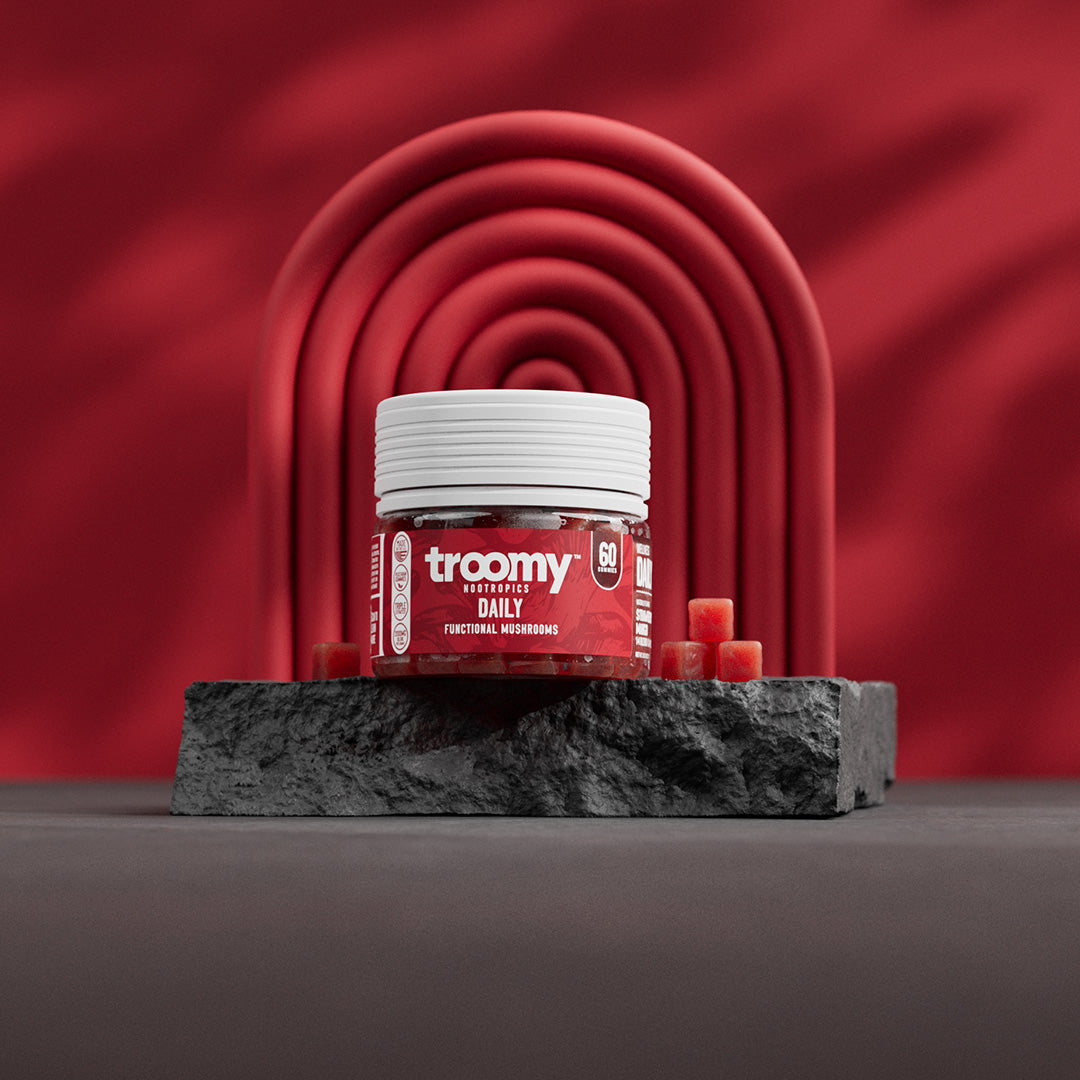
The simplest way to get chaga without foraging, identifying the right fungus, or simmering a pot for an hour is a quality supplement. Our Daily 14 Mushroom Blend Gummies include triple-extracted chaga alongside thirteen other functional mushrooms at 2,000mg per serving, made in the USA, vegetarian, and in a strawberry mango flavor that makes daily use genuinely easy. You get the full-spectrum extraction without sourcing wild fungus, identifying the right growth, or babysitting a simmering pot, which makes it the friendliest entry point for anyone curious about chaga but not interested in becoming a forager.
If you want to focus specifically on immune support, the Immunity Collection gathers our most immune-supportive formulas in one place, so you can find the routine that fits your goals.
Frequently Asked Questions
What is chaga mushroom?
Chaga (Inonotus obliquus) is a fungus that grows on living birch trees in cold northern climates. It forms a hard black mass with a rusty orange interior rather than a typical cap-and-stem mushroom, and it is classified as a medicinal mushroom because of its rich profile of beta-glucans, polyphenols, melanin, betulinic acid, and triterpenes.
Where does chaga grow?
Chaga grows on birch trees in cold climates including Siberia, Russia, Northern and Eastern Europe, Canada, Alaska, and the northern United States. It favors harsh, frigid environments and grows slowly, often taking years to mature, which is part of why sustainable cultivation and extraction matter.
Why is chaga called the king of mushrooms?
The title comes from traditional Russian and Siberian medicine, where chaga has been used medicinally for over a thousand years. It earned royal status for its broad folk-medicine reputation and, in modern terms, for its exceptional antioxidant density and immune-supporting compounds, which make it stand out among medicinal mushrooms.
What does chaga look like?
Chaga has a dark, cracked, charcoal-black exterior that resembles burnt wood, which is actually concentrated melanin, and a striking rusty orange or golden brown interior with a corky, woody texture. Because it can be confused with other birch growths, correct identification matters, which is one reason standardized supplements are popular.
What is chaga used for?
Chaga is used mainly as a daily wellness supplement for antioxidant and immune support, drawing on its beta-glucans, polyphenols, melanin, betulinic acid, and triterpenes. People take it to support immunity, defend against oxidative stress, and support a balanced inflammatory response, especially during flu season, allergy season, and recovery. Most modern evidence is preclinical, so it is best viewed as supportive daily wellness.
Is chaga a mushroom or a fungus?
Chaga is technically a fungus, and the black mass you see is a sterile growth it produces while feeding on the birch tree rather than a typical mushroom. It is commonly and reasonably called a medicinal mushroom because it sits in that category alongside reishi, lion's mane, and cordyceps.
These statements have not been evaluated by the Food and Drug Administration. This product is not intended to diagnose, treat, cure, or prevent any disease.


